
Three Meanings of Tallapoosa County Property Value
The Revenue Commissioner's property pages and the CAMA results remain the official starting point for assessment data. Neither turns a tax figure into a sale forecast. Read every number by its label, source, and date.
| Value | What It Is | Where |
|---|---|---|
| Assessed value | Tax measure after the legal class ratio is applied | Revenue Commissioner record |
| Market or appraised value | County estimate for annual assessment, split into land and improvements | CAMA parcel result |
| Sale consideration | Amount associated with a transfer when the instrument states it | Probate deed |
| Independent appraisal | Opinion of value for a stated purpose and effective date | Licensed appraiser's report |
An exemption can shrink the taxable figure. The appraised value stays put. Family transfers, partial interests, foreclosures, corrective deeds, and estate distributions can all carry consideration that no open-market buyer would pay.
Land and Improvement Values on Tallapoosa CAMA
A public CAMA result packs plenty onto one screen. Expect land value, improvement value, total market value, acreage, use, exemption, yearly tax, owner, account, PPIN, APN, and a deed book, page, and date. Copy the parcel keys with the value. A figure without its deed reference loses its paper trail.
One labeled sample reads $16,300 for land, $156,800 for improvements, and $173,100 in market value on 2.6 acres. A rural record shows $97,800 in land and appraised value, a blank situs field, and 46 deed acres. Neither sample prices typical Tallapoosa County property. They simply show how the screen reports its figures.
Tallapoosa County Reappraises Property Annually
Tallapoosa County reappraises property every year. October 1 fixes ownership and status, and the tax year runs through September 30. The screen and the deed may describe different dates.
Comparing years takes care. Hold the CAMA build, tax year, parcel configuration, land figure, improvement figure, exemption, and class constant. A split, merge, new structure, use change, or new exemption can rewrite the record without any ordinary sale.
The county's official appraisal page explains annual review and the assessment process.
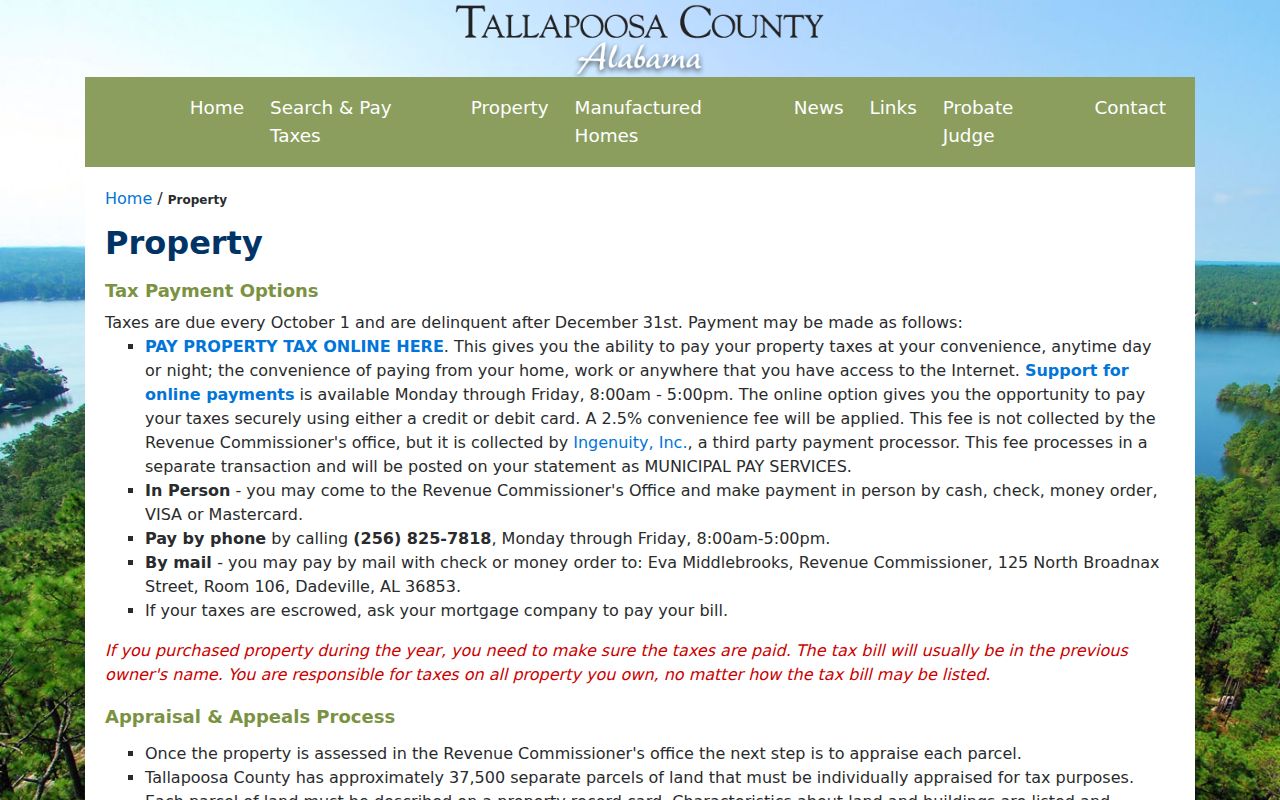
The county's valuation rules explain how the figures are built. The parcel amount still comes from the matching CAMA card.
Look Up a Tallapoosa County Property Value
Use the public Tallapoosa CAMA search for the assessment snapshot. Confirm the land first, then copy figures exactly as labeled.
- Search by physical address, owner, account, PPin, formatted parcel, or subdivision.
- Confirm APN, acreage, district, and deed reference before copying a value.
- Record land, improvements, market or appraised value, exemption, and tax year.
- Follow DBook, DPage, and DDate to Probate if transfer terms matter.
- Put the assessment date and deed recording date on a two-date timeline.
- Assessed value
- The tax measure after the statutory class ratio is applied.
- Market or appraised value
- The county estimate used in assessment administration.
- Assessment ratio
- The percentage Alabama law assigns to a property class.
- Sale consideration
- An amount in a transfer record, not automatically a market benchmark.
Tallapoosa Exemptions Change the Taxable Figure
Homestead, current use, and other lawful classifications can move assessed or taxable value. CAMA's visible Exmt and Use fields are tax clues. They do not prove title, liens, occupancy, or price. An unfamiliar code belongs at the Revenue Commissioner's counter, not in a guess.
Keep the appraised amount separate from the ratio and the exemption. That discipline matters. It keeps a lower taxable figure from being read as a real drop. The property's likely sale value is a different question.
Probate Consideration Is a Separate Value Record
The Probate Office records deeds and related instruments. Direct and reverse indexes run from 1835 to the present. Computer indexing begins in October 1985. Microfilm covers 1979 through 1996. Imaging started in 1996. A CAMA deed reference is only a bridge to the instrument. It is not a hidden last-sale-price field.
Read deed type, parties, legal description, interest conveyed, and consideration together. Older material may need the counter, bound books, microfilm, phone, or a narrow copy request. The public recorder portal stops at a login gate. Treat its post-login fields as unknown.
Lake Martin Context Cannot Set a Tallapoosa Value
Lake geography shapes how buyers weigh frontage, access, private roads, easements, and restrictions. A shoreline label proves little. Neither does a nearby sale. Confirm the recorded easements, parcel acreage, improvements, and city-limit status first.
County and state sources even publish different broad shoreline figures for Lake Martin. That gap is a useful warning against turning regional geography into a precise parcel claim. It is instructive. When the distinction matters, lean on the deed, plat, and current CAMA card. Add a survey and a qualified appraisal.
The 2026 Reval GIS Is a Dated Snapshot
The 2026 Reval interface offers an address search. Its mapper runs quality checks. These flag orphaned polygons, orphaned CAMA records, acreage disparities, and ratio fields. Such controls show active review, not final values.
Save the screen label. If the public portal fails, contact Appraisal and Mapping, use the Revenue Commissioner records-request route, or make a narrow request under Alabama Open Records Law, Ala. Code §36-12-40.
Use Two Dates for Every Tallapoosa Value Check
Start every value check with two dates. One is the assessment or roll date; the other is the deed recording date. Add an execution date, permit date, or improvement completion date only in one case. Do it when an official record actually supplies it. This thin timeline explains a lot. A recently conveyed parcel can still carry older assessment data. A new structure can also appear in a city file before it shows up on the county card.
Never force unlike years into one trend line. Instead, save the source, parcel ID, tax year, land amount, improvement amount, total, use, exemption, and deed reference. Keep each figure tied to its own record. If a parcel split or merge happened, compare the legal descriptions and acreage before comparing totals. A change in the unit being assessed can mimic a price change. It is really a record-structure change.
Tax payment history is a separate stream of evidence. Payment shows whether an amount was paid for a year. It does not prove the owner field is current or the title is clear. It also does not prove the tax amount equals the property's market value.
Request a Missing Tallapoosa Assessment Record
When CAMA comes up empty, contact the Revenue Commissioner's Appraisal and Mapping staff. Make the request narrow. Supply the physical address if known. Also provide the APN, account or PPin, the owner name as printed on an earlier record, the tax year, and the exact fields you need. Ask for the public property record card and value history. Request the land and improvement breakdown, classification, exemption notation, and map reference too. Requesting every document tied to a name only slows things down.
Alabama's Open Records Law supports inspection of public writings, subject to exceptions. State guidance sets no single universal response deadline. Restricted tax data can be withheld or redacted. A focused request is easier to route and price. Ask for electronic delivery when available, and request the legal basis for any denial. For a certified deed or transaction document, take that request to Probate. Don't ask assessment staff to certify title evidence.
What Tallapoosa County Property Value Cannot Prove
A county value proves far less than people assume. It does not prove ownership, clear a lien, establish a boundary, promise a sale price, or measure every improvement's condition on a chosen date. For bill calculation, delinquency, exemptions, and appeal steps, use the Tallapoosa property tax records guide.
Value is not price. A Tallapoosa County assessed value serves taxation. It is neither an independent appraisal nor a guaranteed sale amount.